What is Postnational Art History?
Edited by Charles Green & Ian McLean
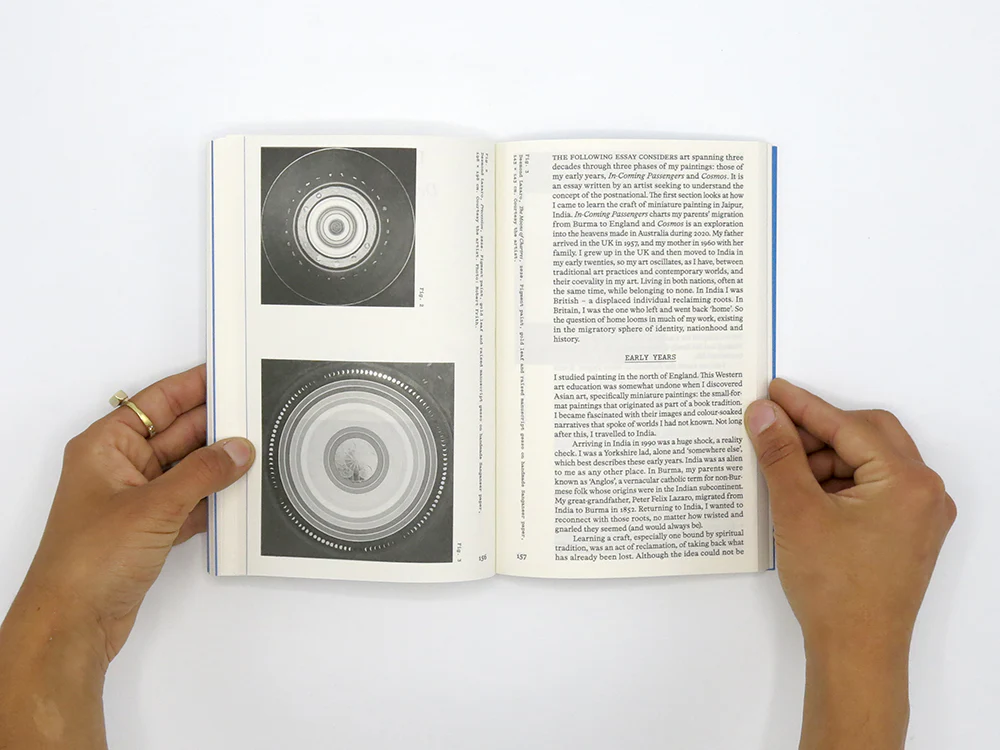
During the past half-century, contemporary art practices, theories and criticism have engaged intently with notions of the postnational. Nonetheless, the presence of the nation-state and nationalisms in art history remain steadfast. In posing the question ‘What is postnational art history?’ this publication aims not for definitive answers, but rather to broach the broader concept of postnationalism and how it might function to disrupt, rethink and complicate established discourses around national art. Edited by Charles Green and Ian McLean, designed by Beaziyt Worcou, and conceived as part of a colloquium of art historians convened at the Buku-Larrngay Mulka Centre – the Yolgnu art centre in Yirrkala, situated in north-east Arnhem Land, in Australia’s Top End – this book aims to tease out and better understand the transnational resonances and connections between artists across cultures and borders that increasingly shape the emerging post-Western world. Through its collection of essays, reflections and conversations – many of which position the iconic collaborative paintings, the Yirrkala Church Panels, as a central motif – What is Postnational Art History? provides an interdisciplinary base for sketching out countless potential futures, and foregrounding Indigenous, diasporic and postcolonial studies, to expand the history of art beyond the default of the nation-state.
CoVA x Perimeter is collaborative publishing initiative curated by the Centre of Visual Art at the University of Melbourne and independent publishing house Perimeter Editions. Foregrounding experimental and otherwise innovative discursive outputs from three key streams of enquiry – Postnational Art Histories, Feminism and Intersectionality, and Art + Science – the program spans research-in-progress, academic dialogues, artist responses, and essays, working to reframe scholarly research via a multiplicity of new perspectives and lenses.
With contributions by: Anna Arabindah-Kesson, Rex Butler, Wulan Dirgantoro, A.D.S. Donaldson, James Elkins, Charles Green, Helen Hughes, Nicholas Jose, Desmond Lazaro, Susan Lowish, Carol Yinghua Lu, Margaret MacNamidhe, Ian McLean, Nina Miall, Nikos Papastergiadis, Claire Roberts, Nur Shkembi, Terry Smith, and Mr Wanambi.
256 pages, 19.5 x 12.5 cm, cold glue bind, softcover, Perimeter Editions x CoVA at the University of Melbourne (Melbourne).
Original: $19.25
-65%$19.25
$6.74More Images




What is Postnational Art History?
Edited by Charles Green & Ian McLean
During the past half-century, contemporary art practices, theories and criticism have engaged intently with notions of the postnational. Nonetheless, the presence of the nation-state and nationalisms in art history remain steadfast. In posing the question ‘What is postnational art history?’ this publication aims not for definitive answers, but rather to broach the broader concept of postnationalism and how it might function to disrupt, rethink and complicate established discourses around national art. Edited by Charles Green and Ian McLean, designed by Beaziyt Worcou, and conceived as part of a colloquium of art historians convened at the Buku-Larrngay Mulka Centre – the Yolgnu art centre in Yirrkala, situated in north-east Arnhem Land, in Australia’s Top End – this book aims to tease out and better understand the transnational resonances and connections between artists across cultures and borders that increasingly shape the emerging post-Western world. Through its collection of essays, reflections and conversations – many of which position the iconic collaborative paintings, the Yirrkala Church Panels, as a central motif – What is Postnational Art History? provides an interdisciplinary base for sketching out countless potential futures, and foregrounding Indigenous, diasporic and postcolonial studies, to expand the history of art beyond the default of the nation-state.
CoVA x Perimeter is collaborative publishing initiative curated by the Centre of Visual Art at the University of Melbourne and independent publishing house Perimeter Editions. Foregrounding experimental and otherwise innovative discursive outputs from three key streams of enquiry – Postnational Art Histories, Feminism and Intersectionality, and Art + Science – the program spans research-in-progress, academic dialogues, artist responses, and essays, working to reframe scholarly research via a multiplicity of new perspectives and lenses.
With contributions by: Anna Arabindah-Kesson, Rex Butler, Wulan Dirgantoro, A.D.S. Donaldson, James Elkins, Charles Green, Helen Hughes, Nicholas Jose, Desmond Lazaro, Susan Lowish, Carol Yinghua Lu, Margaret MacNamidhe, Ian McLean, Nina Miall, Nikos Papastergiadis, Claire Roberts, Nur Shkembi, Terry Smith, and Mr Wanambi.
256 pages, 19.5 x 12.5 cm, cold glue bind, softcover, Perimeter Editions x CoVA at the University of Melbourne (Melbourne).
Product Information
Product Information
Shipping & Returns
Shipping & Returns
Description
Edited by Charles Green & Ian McLean
During the past half-century, contemporary art practices, theories and criticism have engaged intently with notions of the postnational. Nonetheless, the presence of the nation-state and nationalisms in art history remain steadfast. In posing the question ‘What is postnational art history?’ this publication aims not for definitive answers, but rather to broach the broader concept of postnationalism and how it might function to disrupt, rethink and complicate established discourses around national art. Edited by Charles Green and Ian McLean, designed by Beaziyt Worcou, and conceived as part of a colloquium of art historians convened at the Buku-Larrngay Mulka Centre – the Yolgnu art centre in Yirrkala, situated in north-east Arnhem Land, in Australia’s Top End – this book aims to tease out and better understand the transnational resonances and connections between artists across cultures and borders that increasingly shape the emerging post-Western world. Through its collection of essays, reflections and conversations – many of which position the iconic collaborative paintings, the Yirrkala Church Panels, as a central motif – What is Postnational Art History? provides an interdisciplinary base for sketching out countless potential futures, and foregrounding Indigenous, diasporic and postcolonial studies, to expand the history of art beyond the default of the nation-state.
CoVA x Perimeter is collaborative publishing initiative curated by the Centre of Visual Art at the University of Melbourne and independent publishing house Perimeter Editions. Foregrounding experimental and otherwise innovative discursive outputs from three key streams of enquiry – Postnational Art Histories, Feminism and Intersectionality, and Art + Science – the program spans research-in-progress, academic dialogues, artist responses, and essays, working to reframe scholarly research via a multiplicity of new perspectives and lenses.
With contributions by: Anna Arabindah-Kesson, Rex Butler, Wulan Dirgantoro, A.D.S. Donaldson, James Elkins, Charles Green, Helen Hughes, Nicholas Jose, Desmond Lazaro, Susan Lowish, Carol Yinghua Lu, Margaret MacNamidhe, Ian McLean, Nina Miall, Nikos Papastergiadis, Claire Roberts, Nur Shkembi, Terry Smith, and Mr Wanambi.
256 pages, 19.5 x 12.5 cm, cold glue bind, softcover, Perimeter Editions x CoVA at the University of Melbourne (Melbourne).