🚚 Free Worldwide Shipping on All Orders!Shop Now

Michalis Pichler – Every Building on the Ginza Strip / Ginza Haccho
In 1954 Japanese writer and artist Shohachi Kimura published Ginza Haccho, with photographs by Yoshikazu Suzuki of every building on Ginza Street in Tokyo as an accordion foldout book. Twelve years later, Ed Ruscha published Every Building on the Ginza Strip in almost exactly the same style. While the latter has become a touchstone of conceptual publications and artists’ books, its predecessor remains largely unknown.
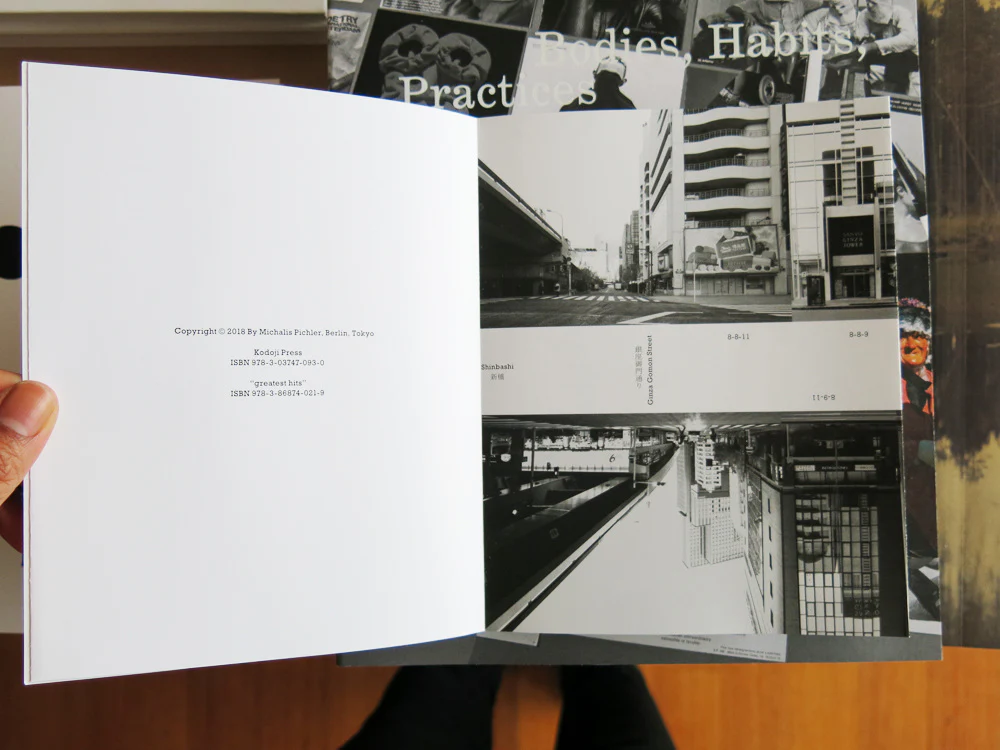
Appropriating Shohachi Kimura’s work, Michalis Pichler’s accordion-folded book opens up to a fourteen-foot strip of photographs of every building on the Ginza street of today, each building identified by a street number. Crossroads are also identified with captions. Photographed from a car driving past, the individual photos were then pasted together to make the long accordion fold. Paper joins are visible throughout the book. Pichler’s version offers a modern update, depicting Ginza street in contemporary Tokyo, where the facades are dominated by glamorous high-end global fashion and luxury brands mixed with local heavyweights.
Within Pichler’s body of work Every Building on the Ginza Strip / Ginza Haccho represents a piece of serial photography, urban phenomenology, ambiguous social critique and art history karaoke.
In a critical essay on appropriation, Pichler describes the karaoke technique as follows: ‘– the strategic use of found and pre-used material, be it image, object, sound, text or thought – the use of an existing layout scheme or corporate identity (see Kippenberger, especially) – the 1:1 use or paraphrase of a historic book title, using the same or alluding words, syntax or rhythm – the reenactment of an “old” concept with “new” material – the reenactment of “old” material with a “new” concept – if a book paraphrases one explicit historical or contemporary predecessor in title, style and/or content, this technique is what I would call a “greatest hit”. By now the appropriation and paraphrasing of Ed Ruscha constitutes a genre of its own.’
460 x 18 cm, leporello fold, housed in a slipcase, 14.4 × 18.4 cm, Kodoji Press (Zurich)
Appropriating Shohachi Kimura’s work, Michalis Pichler’s accordion-folded book opens up to a fourteen-foot strip of photographs of every building on the Ginza street of today, each building identified by a street number. Crossroads are also identified with captions. Photographed from a car driving past, the individual photos were then pasted together to make the long accordion fold. Paper joins are visible throughout the book. Pichler’s version offers a modern update, depicting Ginza street in contemporary Tokyo, where the facades are dominated by glamorous high-end global fashion and luxury brands mixed with local heavyweights.
Within Pichler’s body of work Every Building on the Ginza Strip / Ginza Haccho represents a piece of serial photography, urban phenomenology, ambiguous social critique and art history karaoke.
In a critical essay on appropriation, Pichler describes the karaoke technique as follows: ‘– the strategic use of found and pre-used material, be it image, object, sound, text or thought – the use of an existing layout scheme or corporate identity (see Kippenberger, especially) – the 1:1 use or paraphrase of a historic book title, using the same or alluding words, syntax or rhythm – the reenactment of an “old” concept with “new” material – the reenactment of “old” material with a “new” concept – if a book paraphrases one explicit historical or contemporary predecessor in title, style and/or content, this technique is what I would call a “greatest hit”. By now the appropriation and paraphrasing of Ed Ruscha constitutes a genre of its own.’
460 x 18 cm, leporello fold, housed in a slipcase, 14.4 × 18.4 cm, Kodoji Press (Zurich)
$9.48
Original: $27.09
-65%Michalis Pichler – Every Building on the Ginza Strip / Ginza Haccho—
$27.09
$9.48More Images




Michalis Pichler – Every Building on the Ginza Strip / Ginza Haccho
In 1954 Japanese writer and artist Shohachi Kimura published Ginza Haccho, with photographs by Yoshikazu Suzuki of every building on Ginza Street in Tokyo as an accordion foldout book. Twelve years later, Ed Ruscha published Every Building on the Ginza Strip in almost exactly the same style. While the latter has become a touchstone of conceptual publications and artists’ books, its predecessor remains largely unknown.
Appropriating Shohachi Kimura’s work, Michalis Pichler’s accordion-folded book opens up to a fourteen-foot strip of photographs of every building on the Ginza street of today, each building identified by a street number. Crossroads are also identified with captions. Photographed from a car driving past, the individual photos were then pasted together to make the long accordion fold. Paper joins are visible throughout the book. Pichler’s version offers a modern update, depicting Ginza street in contemporary Tokyo, where the facades are dominated by glamorous high-end global fashion and luxury brands mixed with local heavyweights.
Within Pichler’s body of work Every Building on the Ginza Strip / Ginza Haccho represents a piece of serial photography, urban phenomenology, ambiguous social critique and art history karaoke.
In a critical essay on appropriation, Pichler describes the karaoke technique as follows: ‘– the strategic use of found and pre-used material, be it image, object, sound, text or thought – the use of an existing layout scheme or corporate identity (see Kippenberger, especially) – the 1:1 use or paraphrase of a historic book title, using the same or alluding words, syntax or rhythm – the reenactment of an “old” concept with “new” material – the reenactment of “old” material with a “new” concept – if a book paraphrases one explicit historical or contemporary predecessor in title, style and/or content, this technique is what I would call a “greatest hit”. By now the appropriation and paraphrasing of Ed Ruscha constitutes a genre of its own.’
460 x 18 cm, leporello fold, housed in a slipcase, 14.4 × 18.4 cm, Kodoji Press (Zurich)
Appropriating Shohachi Kimura’s work, Michalis Pichler’s accordion-folded book opens up to a fourteen-foot strip of photographs of every building on the Ginza street of today, each building identified by a street number. Crossroads are also identified with captions. Photographed from a car driving past, the individual photos were then pasted together to make the long accordion fold. Paper joins are visible throughout the book. Pichler’s version offers a modern update, depicting Ginza street in contemporary Tokyo, where the facades are dominated by glamorous high-end global fashion and luxury brands mixed with local heavyweights.
Within Pichler’s body of work Every Building on the Ginza Strip / Ginza Haccho represents a piece of serial photography, urban phenomenology, ambiguous social critique and art history karaoke.
In a critical essay on appropriation, Pichler describes the karaoke technique as follows: ‘– the strategic use of found and pre-used material, be it image, object, sound, text or thought – the use of an existing layout scheme or corporate identity (see Kippenberger, especially) – the 1:1 use or paraphrase of a historic book title, using the same or alluding words, syntax or rhythm – the reenactment of an “old” concept with “new” material – the reenactment of “old” material with a “new” concept – if a book paraphrases one explicit historical or contemporary predecessor in title, style and/or content, this technique is what I would call a “greatest hit”. By now the appropriation and paraphrasing of Ed Ruscha constitutes a genre of its own.’
460 x 18 cm, leporello fold, housed in a slipcase, 14.4 × 18.4 cm, Kodoji Press (Zurich)
Product Information
Product Information
Shipping & Returns
Shipping & Returns
Description
In 1954 Japanese writer and artist Shohachi Kimura published Ginza Haccho, with photographs by Yoshikazu Suzuki of every building on Ginza Street in Tokyo as an accordion foldout book. Twelve years later, Ed Ruscha published Every Building on the Ginza Strip in almost exactly the same style. While the latter has become a touchstone of conceptual publications and artists’ books, its predecessor remains largely unknown.
Appropriating Shohachi Kimura’s work, Michalis Pichler’s accordion-folded book opens up to a fourteen-foot strip of photographs of every building on the Ginza street of today, each building identified by a street number. Crossroads are also identified with captions. Photographed from a car driving past, the individual photos were then pasted together to make the long accordion fold. Paper joins are visible throughout the book. Pichler’s version offers a modern update, depicting Ginza street in contemporary Tokyo, where the facades are dominated by glamorous high-end global fashion and luxury brands mixed with local heavyweights.
Within Pichler’s body of work Every Building on the Ginza Strip / Ginza Haccho represents a piece of serial photography, urban phenomenology, ambiguous social critique and art history karaoke.
In a critical essay on appropriation, Pichler describes the karaoke technique as follows: ‘– the strategic use of found and pre-used material, be it image, object, sound, text or thought – the use of an existing layout scheme or corporate identity (see Kippenberger, especially) – the 1:1 use or paraphrase of a historic book title, using the same or alluding words, syntax or rhythm – the reenactment of an “old” concept with “new” material – the reenactment of “old” material with a “new” concept – if a book paraphrases one explicit historical or contemporary predecessor in title, style and/or content, this technique is what I would call a “greatest hit”. By now the appropriation and paraphrasing of Ed Ruscha constitutes a genre of its own.’
460 x 18 cm, leporello fold, housed in a slipcase, 14.4 × 18.4 cm, Kodoji Press (Zurich)
Appropriating Shohachi Kimura’s work, Michalis Pichler’s accordion-folded book opens up to a fourteen-foot strip of photographs of every building on the Ginza street of today, each building identified by a street number. Crossroads are also identified with captions. Photographed from a car driving past, the individual photos were then pasted together to make the long accordion fold. Paper joins are visible throughout the book. Pichler’s version offers a modern update, depicting Ginza street in contemporary Tokyo, where the facades are dominated by glamorous high-end global fashion and luxury brands mixed with local heavyweights.
Within Pichler’s body of work Every Building on the Ginza Strip / Ginza Haccho represents a piece of serial photography, urban phenomenology, ambiguous social critique and art history karaoke.
In a critical essay on appropriation, Pichler describes the karaoke technique as follows: ‘– the strategic use of found and pre-used material, be it image, object, sound, text or thought – the use of an existing layout scheme or corporate identity (see Kippenberger, especially) – the 1:1 use or paraphrase of a historic book title, using the same or alluding words, syntax or rhythm – the reenactment of an “old” concept with “new” material – the reenactment of “old” material with a “new” concept – if a book paraphrases one explicit historical or contemporary predecessor in title, style and/or content, this technique is what I would call a “greatest hit”. By now the appropriation and paraphrasing of Ed Ruscha constitutes a genre of its own.’
460 x 18 cm, leporello fold, housed in a slipcase, 14.4 × 18.4 cm, Kodoji Press (Zurich)