🚚 Free Worldwide Shipping on All Orders!Shop Now

Chris Lee – Immutable: Designing History
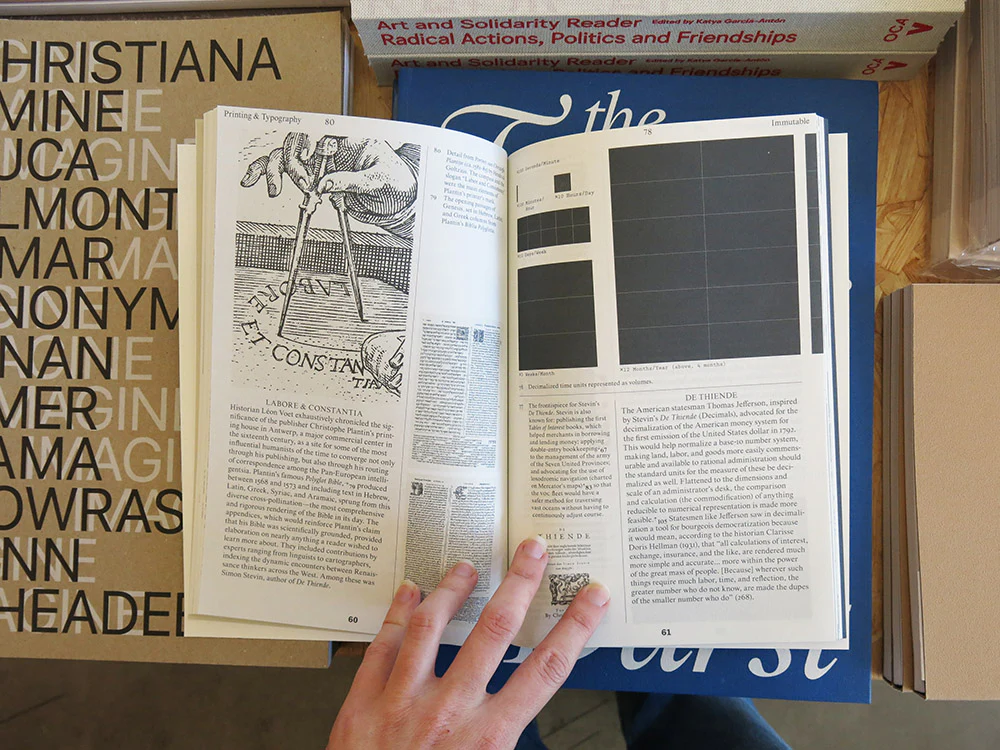
Immutable: Designing History explores the banal genre of the document and its entanglement with statecraft and colonial(ism/ity). This is framed as a ~5,000 year chronology, imbricating the developments of money and writing — from Mesopotamian clay tablets to distributed ledgers, like the blockchain. Immutability figures as a design imperative and hermeneutic for considering a variety of techniques (material, technological, administrative, etc.) of securitisation against the entropy of a document’s movement through space/time, and the political.
This project is driven by a contrast: design educators tend to teach forms like logos, books, websites, etc., but not passports, money, property deeds, etc., in spite of these being, I contend, design’s most profoundly consequential forms.
As an alternative historiography, Immutable gestures both towards anthropologist Laura Nader’s call to 'study up' (on those in power), and the radical educator Paolo Freire’s recognition of the 'limit situation' as a generative condition for emancipatory praxis. The book’s aim is to orient graphic design towards the vocation of imagining, naming, and remembering beyond the horizons of its role as a managerial, administrative, and colonial instrument that imposes a rationality of vision and accountability upon what is knowable, thinkable and sayable. – Chris Lee
192 pages, 12.7 x 19.7cm, softcover, Onomatopee (Eindhoven).
This project is driven by a contrast: design educators tend to teach forms like logos, books, websites, etc., but not passports, money, property deeds, etc., in spite of these being, I contend, design’s most profoundly consequential forms.
As an alternative historiography, Immutable gestures both towards anthropologist Laura Nader’s call to 'study up' (on those in power), and the radical educator Paolo Freire’s recognition of the 'limit situation' as a generative condition for emancipatory praxis. The book’s aim is to orient graphic design towards the vocation of imagining, naming, and remembering beyond the horizons of its role as a managerial, administrative, and colonial instrument that imposes a rationality of vision and accountability upon what is knowable, thinkable and sayable. – Chris Lee
192 pages, 12.7 x 19.7cm, softcover, Onomatopee (Eindhoven).
$27.09
Chris Lee – Immutable: Designing History—
$27.09
More Images




Chris Lee – Immutable: Designing History
Immutable: Designing History explores the banal genre of the document and its entanglement with statecraft and colonial(ism/ity). This is framed as a ~5,000 year chronology, imbricating the developments of money and writing — from Mesopotamian clay tablets to distributed ledgers, like the blockchain. Immutability figures as a design imperative and hermeneutic for considering a variety of techniques (material, technological, administrative, etc.) of securitisation against the entropy of a document’s movement through space/time, and the political.
This project is driven by a contrast: design educators tend to teach forms like logos, books, websites, etc., but not passports, money, property deeds, etc., in spite of these being, I contend, design’s most profoundly consequential forms.
As an alternative historiography, Immutable gestures both towards anthropologist Laura Nader’s call to 'study up' (on those in power), and the radical educator Paolo Freire’s recognition of the 'limit situation' as a generative condition for emancipatory praxis. The book’s aim is to orient graphic design towards the vocation of imagining, naming, and remembering beyond the horizons of its role as a managerial, administrative, and colonial instrument that imposes a rationality of vision and accountability upon what is knowable, thinkable and sayable. – Chris Lee
192 pages, 12.7 x 19.7cm, softcover, Onomatopee (Eindhoven).
This project is driven by a contrast: design educators tend to teach forms like logos, books, websites, etc., but not passports, money, property deeds, etc., in spite of these being, I contend, design’s most profoundly consequential forms.
As an alternative historiography, Immutable gestures both towards anthropologist Laura Nader’s call to 'study up' (on those in power), and the radical educator Paolo Freire’s recognition of the 'limit situation' as a generative condition for emancipatory praxis. The book’s aim is to orient graphic design towards the vocation of imagining, naming, and remembering beyond the horizons of its role as a managerial, administrative, and colonial instrument that imposes a rationality of vision and accountability upon what is knowable, thinkable and sayable. – Chris Lee
192 pages, 12.7 x 19.7cm, softcover, Onomatopee (Eindhoven).
Product Information
Product Information
Shipping & Returns
Shipping & Returns
Description
Immutable: Designing History explores the banal genre of the document and its entanglement with statecraft and colonial(ism/ity). This is framed as a ~5,000 year chronology, imbricating the developments of money and writing — from Mesopotamian clay tablets to distributed ledgers, like the blockchain. Immutability figures as a design imperative and hermeneutic for considering a variety of techniques (material, technological, administrative, etc.) of securitisation against the entropy of a document’s movement through space/time, and the political.
This project is driven by a contrast: design educators tend to teach forms like logos, books, websites, etc., but not passports, money, property deeds, etc., in spite of these being, I contend, design’s most profoundly consequential forms.
As an alternative historiography, Immutable gestures both towards anthropologist Laura Nader’s call to 'study up' (on those in power), and the radical educator Paolo Freire’s recognition of the 'limit situation' as a generative condition for emancipatory praxis. The book’s aim is to orient graphic design towards the vocation of imagining, naming, and remembering beyond the horizons of its role as a managerial, administrative, and colonial instrument that imposes a rationality of vision and accountability upon what is knowable, thinkable and sayable. – Chris Lee
192 pages, 12.7 x 19.7cm, softcover, Onomatopee (Eindhoven).
This project is driven by a contrast: design educators tend to teach forms like logos, books, websites, etc., but not passports, money, property deeds, etc., in spite of these being, I contend, design’s most profoundly consequential forms.
As an alternative historiography, Immutable gestures both towards anthropologist Laura Nader’s call to 'study up' (on those in power), and the radical educator Paolo Freire’s recognition of the 'limit situation' as a generative condition for emancipatory praxis. The book’s aim is to orient graphic design towards the vocation of imagining, naming, and remembering beyond the horizons of its role as a managerial, administrative, and colonial instrument that imposes a rationality of vision and accountability upon what is knowable, thinkable and sayable. – Chris Lee
192 pages, 12.7 x 19.7cm, softcover, Onomatopee (Eindhoven).